China: The Tourist Road
The
Silk Road may be no more but the Chinese clearly authorities hope that
the
tourist road is about is about to take over. They may be right.
"Perhaps
we could take potluck, like in Japan." said my wife. A glance at the
guidebook
put paid to that idea - no public toilets and potential severe language
problems. No, not potluck, not in China, not on our first visit. The
beauties
of tourist fare usually leave us cold but for once we opted for a
guided tour:
safe, sanitised and visiting the places where the Chinese want to take
us.
Perhaps we are getting old but, at least until the Olympics in 2008
when the
Chinese government is pledged to open up the country, this is the
likely
preferred option of most visitors.
My
wife was working in Hong Kong for a few days and our dates did not
correspond
to any pre-arranged tours. Two tour operators offered us personal
itineraries
which fitted our timetable: one staying in five star hotels at
£2000 and the
other (China Travel Service) in four stars at just over £1000
with similar
excursions. We chose cheapskate. Our flight from Hong Kong was arranged
by CTS
but those booking their own travel from HK would save by taking the
train to
Guangzhou or Shenzhen and taking an internal flight from there.
Hurricanes
and Jellyfish in Guilin
First
stop was Guilin. We were met, not by our rep, but by another company
employee
with his 18-month-old daughter who was spoken to by her father only in
English
and by her mother in Chinese -"say hello to auntie and Uncle" he said. We did not catch her name but we
understood its meaning to be a combination of water and forest: a
reference to
the increased awareness of environmental issues now being promoted by
the
Chinese government.
It
was the May Day holiday week for the first few days of our stay which
meant
that, particularly in the tourist city of Guilin, there were very many
Chinese
on holiday resulting in larger crowds than normal and prices about 15%
higher.
There are two main holidays in China, May Day week and the first week
in
October. These dates are probably best avoided, although we did see a
side to
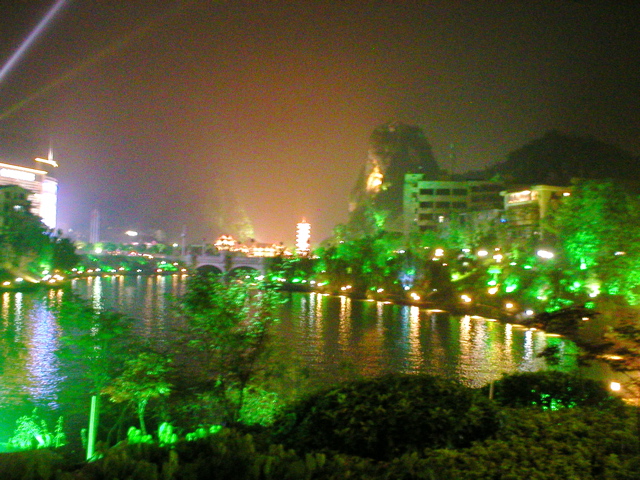
the Chinese that we might otherwise have missed. Arriving in the
evening the
vegetation around Guilin lakeside, along with the surrounding limestone
rocks
and substantial fake waterfall, were lit up like Blackpool with green
and
purple lights. Around the lake, a group of Chinese housewives were
singing in a
circle, watched by their less spontaneous husbands. Small children
tried out
their few words of English. Lovers walked round the lake looking in
vain for a
quiet spot. Perhaps they would find one in the hills next day but we
suspected
that hiking was not their thing, judging by the designer clothes and
high
heels. My wife found it all very romantic. Crossing a road led to our
first
experience of the traffic pollution. The cars were modern but lack of
emission
control laws means that the manufactures are happy to skimp on the
engines and,
despite the light evening traffic, each car's exhaust left an eye
stinging smell
which reminded me of the Bluebird coaches which used to ply British
roads in
the early 60s, if any readers can remember those.
Leopard,
eagle and bamboo rat were on the menu that evening, all of which we
left alone
and chose more familiar fare, though a side bowl of jellyfish did make
an
appearance. Our four star hotels were of comparable standard to those
in the
UK. At Guilin the usual raft of complimentary shampoos, toothbrushes
toothpastes and combs in the bathroom were supplemented by a number of
packets
of underwear and other items, clearly labelled 'uncomplimentary'.
Western
breakfast was available if required and was much appreciated. The
Chinese eat
with such appreciation and gusto. They do love their food.
There
are many attractions around Guilin, all exploited to the full with
prices
frequently higher for non-Chinese. We visited a tea plantation to learn
about
the five types of china tea and to hear much justified scorn heaped
upon our
tea bag culture. A cable car to the top of a mountain proved enjoyable
and a
visit to the impressive Reed Flute limestone caves produced a most
dramatic
ending to our visit. As we were leaving the cave there was a gush of
wind into
the exit tunnel reminiscent of the sort of gust sometimes experienced
in the London
tube. As we emerged the world turned dark and the wind was whipping
itself up
into considerable fury. I was surprised to see the local people getting
very
excited assuming that, with the well-known hurricane season in Hong
Kong, such
winds were not unusual, though perhaps unseasonable but such storms are
apparently unknown in inland China. It seemed that my wife and I were
probably
the only ones there to have experienced such winds, being survivors of
the
epicentre of the '87 hurricane in the UK and not a few Scottish gales.
From the
safety of the stone entrance building to the cave we watched as the
wind did
indeed reach hurricane force with massive howling and horizontal rain
reducing
visibility into the surrounding woods to only a few feet. The
frightening winds
lasted for about 10 minutes to be followed by a downpour that was
clearly here
to stay. We ran through the rain to the waiting car and drove into
Guilin,
expecting a disaster but, although a few trees and hoardings were down,
they
clearly had not experienced the type of winds we had witnessed higher
up. We
concluded that the winds we had experienced were the result of
funnelling
through the cleft in the limestone hills that contained the entrance to
the
cave. A once in a lifetime experience, shared by the hundred or so
people who
happened to be up there at the time.
Cormorant
fishing and shopping in Yanghsuo
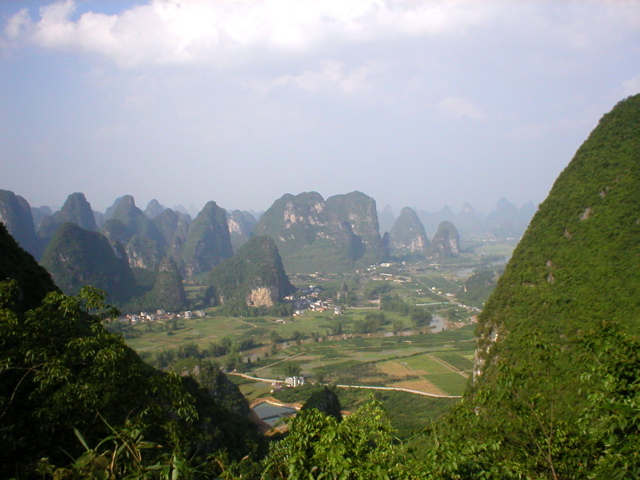
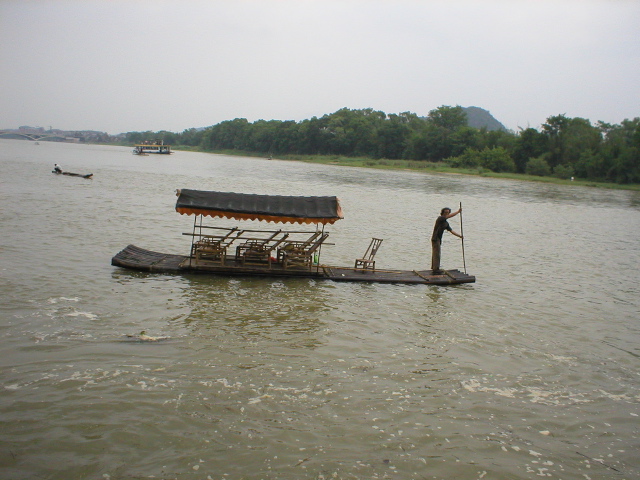
Next day, a three-hour Cruise down the river Li to Yangshuo passing through limestone conical hills which we were told had risen out of the sea but I suspect were formed by erosion of the surrounding less durable sedimentary rocks. However they were formed, the landscape hereabouts is spectacular. We were rather expecting hard benches on the boat but we were given a table to share with a pleasant American couple and were well fed over lunch. The other westerners present were mostly from a German party. There was a degree of segregation from the Chinese who, for the most part, were on a lower deck in cheaper accommodation. Paddy field, small farms, pigs, water buffalo, goats, picnickers and the occasional hiker comprised the riverside scene. Towards the end of the journey we started to see bamboo craft, either in the form of ferries, houseboats or fishing vessels. These craft, made of a single layer of bamboo lie very low in the water and, from a distance, appear to be sinking. They are rowed, skulled or punted, according to depth of water by the famous cormorant fishermen. They fish either with nets or using their tame cormorants, which they keep tied to a cruciform stick. A rope is tied round the cormorant's neck such that is unable to swallow any fish it catches allowing the fisherman to remove the fish from its beak. Traditionally they are allowed to eat every seventh fish. Apparently a cormorant kept in this fashion can last for up to 10 years. Close up, the cormorants appeared sleek, bright eyed and at home with their fisherman owners. Of all ages, in their conical straw hats and three quarter length trousers, punting their water level craft with the background of paddy fields and fantasy limestone mountains, these fishermen are the subject of many a Chinese painting and represent every westerner's idea of what rural China should look like, just as long as one can ignore their mobile phones and the Hondas parked at the waterside. We were to see the cormorant fishermen later that evening in different circumstances.
Great bargains
are to be had in Yangshuo
and also in the flea markets in Beijing but rather less so in Shanghai.
'Bargain' being the operative word. Prices start higher for tourists
and you
can think in terms of a half or a third of the first quote. Most people
are
happy with a few souvenir T-shirts etc gained at prices below those at
home but
serious shoppers with hours of patience and an empty suitcase could
retrieve
their airfare if they bought things they would otherwise have bought at
home.
There are two price structures: one for the locals and another for you.
Watching the locals purchase a similar item can be an eye opener and
making it
clear to the shopkeeper that you have observed the money change hands
may help
to break down the tourist price barrier but, even so, you can still
expect to
pay more. There is little point in getting a local to help, as they
have a
vested interest in maintaining the differential and no point at all in
losing
your temper. Good humour and patience is the rule. We met two women
living in
Beijing who lived by teaching English and who funded their trips back
home to
the States by organising garage sales.
The
Wall and the Warriors
The
day we left for Xian to see the Terracotta Warriors was not an
auspicious one
for travel. We arrived at Guilin airport to find a large number of
people
apparently camping out at our departure gate. They were tourists from
Shenzhen who had come to
enjoy the May week holiday
and were now on their way home. Their 'plane had been cancelled 20
hours ago
and they had been waiting ever since, apparently with no explanation
nor
indication of when they could go home. Shortly after we arrived they
decided to
do something and who could blame them. There is little point in them
calling
the press or television as such events are rarely reported by the
government-controlled media so they blockaded the security gates and
brought the
conveyor belts to a stop with much chanting and fist waving. The police
arrived
and there was a brief scuffle but eventually the police allowed their
blockade
and formed a grim-faced line in front of the belts with the protesters
taking
flash photographs of them full in their faces. The blockade lasted half
an hour
and then, presumably by mutual agreement, things got moving again. A
massive
crowd had grown outside the departure lounge and all flights had to be
delayed
as there were no passengers getting through. Whether they ever got
their flight
or not I don't know, for a rumour went round that our flight was about
to board
from gate one, not seven as on the boarding card. There were no
announcement
boards at Guilin, only loud speakers with some announcements in English
but
these were difficult to hear. Eventually we boarded from gate two. Not
surprisingly, some passengers were missing and we waited half an hour
whilst
they were found, presumably still at gate seven. A 'mechanical problem'
tried
our patience for another half hour and then we were off! At the other
end a
large static queue had built up inside the airport car park, due to
closure of
all main roads during the visit of a member of the Taiwan opposition.
After he
had gone by, the resulting traffic jam was left to sort itself out. Our
driver
was furious that he had to pay more to get out of the car park due to
the
queue. Apart from the warriors, there are plenty of historical
monuments in
Xian. We particularly enjoyed an evening visit and meal in the Muslim
quarter.
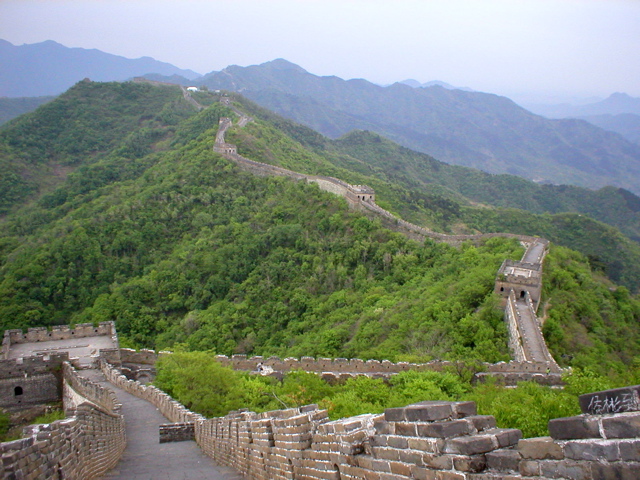
There is little I can add to the large body of literature describing
China's
great tourist attractions; suffice to say that neither the Warriors nor
the
Great Wall were disappointments. Tiananmen Square's dimensions are
still
impressive but would be so much more so without Mau's mausoleum in the
way.
In
Beijing, we could have done with longer than the scheduled half day at
the
Forbidden City. Outside the walls: the usual postcard hawkers, 'Rolex'
watch
sellers and organised gangs of begging children, clearly co-ordinated
by an
unseen hand, were supplemented by a number of individuals with various
physical
deformities including blindness and horrific facial burns. Apparently
some
beggars make a reasonable living but clearly not all can do so. There
is
unemployed pay but, if one moves to a big city and becomes homeless,
the local
authority is reluctant to encourage more migrants by being too
generous: a
problem familiar to anyone dealing with the homeless in our own large
cities.
The main difference is that there is no NHS equivalent in China and all
health
care has to be paid for, resulting in large numbers of untreated
illnesses and
deformities. We saw one young girl, unable to walk, lying on a
makeshift
trolley with her deformed feet exposed. She appeared to have leprosy.
The
contrast with the treasures within the Forbidden City was stark. Buddhist monks used to help by
distributing 'Buddhist porridge' to the destitute poor but apparently
no longer.
In many public squares we observed the art of kite flying, practice and
gentle
persuasion is needed to get them up in the minimal winds at ground
level but
the heights the more experienced flyers can obtain were incredible.
Cixi
and Peking Opera
I
was fascinated by the well-known story of Cixi, the dowager Empress, a
minor
concubine of the Emperor Xianfeng, who happened to be the mother of his
only
son. After Xianfeng died her son became Emperor. He died young and her
nephew
assumed the throne but Cixi retained the true power. A traditionalist,
she had
no time for reform. Her nephew, however, felt the defeat of China
during the
opium wars very keenly and, advised by his favourite concubine,
insisted on
change within the armed forces and of Chinese society in general. Cixi,
though,
was the better-connected politician and had him held prisoner in the
summer
palace where the bricks used to confine him can still be seen. She
spent the
money destined for reform of the navy on treasures for the Forbidden
City,
recently desecrated by the British and had the concubine thrown down a
well.
Her nephew may have consoled himself with the thought that he would
probably
outlive her but he died (probably poisoned) one day before Cixi in
1908. Cixi
was addicted to the Peking opera and what a fine story for an opera her
own
life would make.
Despite
being watered down for tourists, a visit to the Peking opera was a
stunning
experience. The trained female singers take some getting used to but
the
martial arts inspired acrobatics and juggling was awesome.
The taxi driver home tried not to put
the meter on but we insisted, after threatening to walk out of the cab
and
letting him know we had a map and were therefore not expecting the
journey to
be unnecessarily prolonged. All taxis are metered in China, although
the rules
seem to change after 11-30 or so. Watch out for short change in the
form of
near useless Mau notes rather than Yuan.
Shanghai,
Politics and Trains
We
took a train from Shanghai to the garden city Shuzhou. There was a long
queue
for of tickets but we had been forewarned of this. There are two
classes: hard
seat and soft seat. Soft seat is equivalent to the UK second class.
Hard seat
gets you close to the people but are not too uncomfortable. Thankfully
no-smoking rules are enforced. This gave us some insight as to how
feasible
independent travelling might be.
Perfectly possible between the big cities we concluded. Public
toilets,
many with western style design, rather than squats, are becoming
commonly
available but only the most intrepid travellers are likely to be
successful
outside the cities without guides. We understood that hygiene standards
in much
of the country hostelries still leave much to be desired. People were
invariably friendly and wished us well and never during the whole of
our time
in China did we feel threatened. On the flight back to the UK we read
that
Railtrack executives had just organised themselves large bonuses,
despite
continuing poor performances. The underground from Heathrow to Victoria
was
fine but at Victoria things began to go wrong. There was a queue for
tickets,
almost as long as that at Shanghai station. The ticket machines
installed at
Victoria were incapable of giving a discount for our travel card so we
waited
in the queue. A gentle complaint to the ticket office manager resulted
in the
information that new machines had been purchased but could not be
installed
because of a possible fire risk. We missed one train whilst waiting in
the
queue. The next train had sat in the station for twenty minutes after
its
departure time when there was an announcement that another train on
distant
platform was leaving for our destination. So we all disembarked and ran
the
length of Victoria station, scrambling for seats. At least the Chinese
trains
were on time, seats are pre-booked and their system is presumably
without the
extra financial burden of paying bonuses to executives who buy
expensive
tickets machines that canÕt then be installed.
We
enjoyed Shanghai perhaps because it is effectively a westernised city,
although
rather cleaner than most. A visit to Nanjing
Road for my wife to be fitted for a silk dress and myself for a couple
of suits
to be ready in two days time was followed by a walk along the river
front to
gaze across to Pudong, which 10 years ago was mostly fields but now is
home to
a massive business community and some of the tallest building on earth,
some
with quite stunning architecture. Also a futuristic train, drawn by
magnets,
which will whisk the Pudong inhabitants to the airport at 400 km per
hour.
Towards the end of the walk there is a burst of magnificent fireworks
reflected
in the water and right at the end, in a small park, two singers, male
and
female, have attracted a small crowd by singing traditional Chinese
folk songs,
just for the love of it. The city is kept clean as a result of the
system for
providing employment for as many of the citizens of Shanghai as
possible. Those
who have lost their jobs may become temporary street cleaners or even
whistle
blowers at street corners. Traffic is controlled by the police but the
pedestrians at busy interfaces are controlled by people with whistles
who
ensure that the pedestrian lights are adhered to by sounding off very
loudly at
anyone who puts a toe over the pavement at the wrong phase of the
lights. ItÕs
all quite good humoured and they do help the pedestrians by, for
instance,
ensuring they stand well away from puddles where they may get splashed.
They
seemed to enjoy their position and blow their whistles perhaps rather
more
loudly and more often than is necessary. I quite fancied a go myself.
Walking
back along the other side of the road, away from the river, we could
admire the
older buildings of the Bund with classical facades and Art Deco
interiors.
These were mostly old Banks, from which the concessionists powers
financed
their appalling racist complacency from the twenties, to their sudden
demise in
the forties. On to the Peace Hotel to hear the Old Boys jazz band. A
legendary
group of players now mostly in their 60s, with the oldest at 75. The
group
started playing here in the thirties. Driven out by the Cultural
Revolution,
they disappeared, only to turn up one evening 10 years later and resume
playing. The jazz was a bit pedestrian but some younger musicians
displaced
them at around 11 pm and the music began to swing a little, as no doubt
theirs
had done in earlier years. Their story is as fine a metaphor for the
history of
Shanghai in the 20th centaury as you could wish, for
Shanghai is the
centre of an economic miracle that has resulted in growth of
breathtaking
dimensions. The youth are optimistic that personal wealth is just
around the
corner and there is no doubt that the government has had a major
success here.
But the country is still led by a fragile, authoritarian and somewhat
corrupt
elite whose military killed several thousand of their own
citizens in Tiananmen
Square for daring to question their rule. The perpetrators of this deed
have
yet to be brought to book. Centauries of Emperor worship and years of
Mao
worship have diluted any concept of personal responsibility in much of
the
populace. A discussion of an ancient statue, severely damaged during
the
Cultural Revolution, produced the opinion that the person who had done
the
damage was not in any way responsible. Only the gang of four were
responsible,
for the people were only carrying out orders – 'like soldiers'. The
recent riots against the Japanese property and residents were regarded
as
something of a success, as an apology was gained from the Japanese for
war
crimes, These riots were openly regarded as government inspired.
Massive
growth, dependant on foreign investment, with a population that has
surrendered
personal responsibility over to government that is generally
acknowledged to be
corrupt and unresponsive, seems an unlikely recipe for stability. The
wrong
decision by a government representative, resulting in a misplaced
racially
motivated disturbance, could rapidly drain the offices and hotels of
Pudong and
collapse the whole pack of cards. Government reform along with the
economic miracle
is sorely needed.
I
sent a copy of this article to Chinese acquaintances for comments. The
e-mails,
which work perfectly well otherwise, were returned undelivered. This
sort of
censorship seems incompatible with the promises for the forthcoming
Olympics.
Lakes,
Cliffs and Song
And
what of the cormorant fishermen? On our last evening at Yangshuo we
were to be
taken by our enthusiastic young rep to the local Peking style opera.
Hints
about the special nature of the theatre indicated that we were in for a
surprise so we asked no further questions. Attending
by car is a nightmare so, inches away from the
traffic jam crowding along the country road to the show, we walked the
mile or
so to the park area containing the theatre. A number of buildings were
set in
the park for entertainment purposes, including a recently built
traditional
style Chinese theatre. We passed by these to walk round a large
limestone rock
to enter a natural limestone amphitheatre, set with a large rack of
steeply
rising seats on a bamboo scaffolding. The stage was completely dark,
apart from
a screen showing a film of the credits in Chinese lettering and scenes
of the
surrounding countryside. The screen was reflected below and there was
clearly
water about. Suddenly the screen disappeared and the 'stage' was in
total
darkness. To gasps of astonishment from the audience, who must have all
been in
on the secret and to tears in my own eyes at the sight, the show
commenced.
Centre stage, lit by a single spotlight from heaven knows where, was a
single
female actor in a boat, singing a plaintive Chinese folk song. The
stage
was otherwise pitch black with the background lit by coloured
floodlights. I
had little idea what the show was about and the music was more West End
than
traditional Peking but this mattered not a bit as this was all about
spectacle
- the sort of spectacle that the West End and Broadway could only dream
about.
For the stage was a natural lake about the size of lake Buttermere and the backdrop 300 foot
sheer limestone
cliffs, lit according to mood. Our friends the cormorant fishermen, who
also
took an active part in the production, skimmed the actors across the
lake
appearing from the sides or from between the limestone cliffs
surrounding the
lake. At one stage they pulled about 20 sheets of red material from one
side of
the lake to the other moving them up and down in a co-ordinated fashion
to
simulate waves. There was a cast
of six hundred, 80 % of them locals, the rest professional and two
shows a
night. Who was it that said tourist fare wasnt beautiful?
Dr Ian Runcie is a medical doctor living in Sussex in the UK. He has
written on a number of subject including opera and, in particular Wagner's Ring.
photos